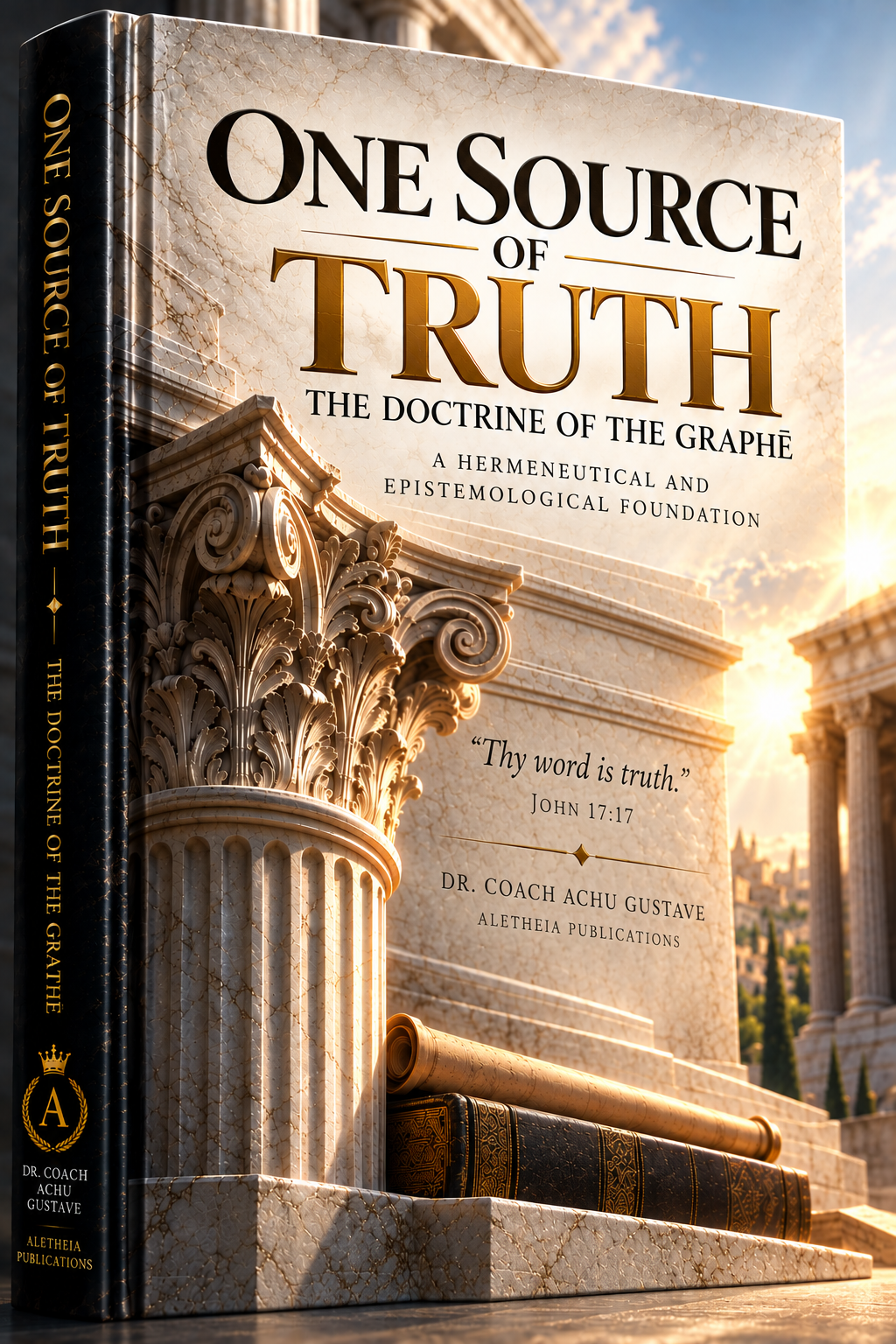
 The Doctrine of the Graphē · A hermeneutical and epistemological foundation
Gate book · $100
One Source of Truth
The Doctrine of the Graphē · A hermeneutical and epistemological foundation
What makes something true—and how can we know?
We live among competing claims about what is true. Some are inherited. Others are taught, discovered, interpreted, or accepted because we trust the people who present them. Some become so familiar that questioning them feels unnecessary. Others are defended with such confidence that confidence itself begins to look like evidence.
Yet a claim may be sincerely believed, widely accepted, logically appealing, institutionally endorsed, and repeatedly asserted—and still be false.
Dr. Coach Achu Gustave
- 1. What Is Truth?Entitlement required
- 2. Truth and RealityEntitlement required
- 3. Truth and ErrorEntitlement required
- 4. Knowledge, Evidence, and Rational WarrantEntitlement required
- 5. Reason, Inference, and RatiocinationEntitlement required
- 6. Dianoetic Thinking and Sound JudgmentEntitlement required
- 7. Isaiah 1:18: “Let Us Reason Together”Entitlement required
- 8. The Problem of Ultimate AuthorityEntitlement required
- 9. What Grounds Truth?Entitlement required
- 10. God as the Ground of TruthEntitlement required
- 11. The Truthfulness, Faithfulness, and Immutability of GodEntitlement required
- 12. God Cannot LieEntitlement required
- 13. Knowing God: Revelation Rather Than SpeculationEntitlement required
- 14. The Problem With Human Accounts About GodEntitlement required
- 15. What Is the Bible?Entitlement required
- 16. The Bible as Divine Library and Written RecordEntitlement required
- 17. The Bible in History: Record, Continuity, and Historical CorrespondenceEntitlement required
- 18. THE BIBLE AS EYEWITNESS AND APOSTOLIC TESTIMONYEntitlement required
- 19. The Bible's Own Claims About Its OriginEntitlement required
- 20. What Is γραφή (*graphē*)?Entitlement required
- 21. G1124 — Writing, Holy Writ, and ScriptureEntitlement required
- 22. Graphē, Holy Writ, Scripture, Bible, and Written WordEntitlement required
- 23. God Speaking: The Audible VoiceEntitlement required
- 24. Angels and Prophetic MediationEntitlement required
- 25. ProphetsEntitlement required
- 26. Jesus ChristEntitlement required
- 27. ApostlesEntitlement required
- 28. Visions and DreamsEntitlement required
- 29. RevelationEntitlement required
- 30. InspirationEntitlement required
- 31. “All Scripture”Entitlement required
- 32. From Divine Communication to Written TestimonyEntitlement required
- 33. What Is Authentication?Entitlement required
- 34. Evidence and Historical TestimonyEntitlement required
- 35. Eyewitnesses and Credible WitnessesEntitlement required
- 36. Divine Manifestation and MiraclesEntitlement required
- 37. Prophecy and FulfillmentEntitlement required
- 38. Unity, Continuity, and Internal CoherenceEntitlement required
- 39. Historical and External CorroborationEntitlement required
- 40. Manuscripts, Transmission, and PreservationEntitlement required
- 41. The Cumulative Evidential CaseEntitlement required
- 42. From Evidence to Rational WarrantEntitlement required
- 43. Jesus Christ in the Historical RecordEntitlement required
- 44. Christ, Truth, and Divine RevelationEntitlement required
- 45. The Claims and Works of ChristEntitlement required
- 46. The Death and ResurrectionEntitlement required
- 47. The Eyewitness TestimonyEntitlement required
- 48. Christ's Confirmation of ScriptureEntitlement required
- 49. Christ and the Apostolic WitnessEntitlement required
- 50. The Authority of the Apostolic TestimonyEntitlement required
- 51. The Scriptural CorpusEntitlement required
- 52. The Canon and Its RecognitionEntitlement required
- 53. Prophetic and Apostolic AuthorityEntitlement required
- 54. The Unity of the Written TestimonyEntitlement required
- 55. Revelation, Inspiration, and Canon DistinguishedEntitlement required
- 56. What Inspiration GuaranteesEntitlement required
- 57. Why Scripture Is an Infallible RecordEntitlement required
- 58. Truth, Authority, and the Written WordEntitlement required
- 59. John 10:34–36Entitlement required
- 60. “I Said, Ye Are Gods” — Psalm 82:6Entitlement required
- 61. Christ's Reasoning From What Is WrittenEntitlement required
- 62. “The Scripture Cannot Be Broken”Entitlement required
- 63. Why Scripture Cannot Be BrokenEntitlement required
- 64. John 17:17 — “Thy Word Is Truth”Entitlement required
- 65. Why the Graphē Is the Primary Written AuthorityEntitlement required
- 66. Authority of Scripture Versus Authority of InterpretationEntitlement required
- 67. How Scripture Is MisreadEntitlement required
- 68. Theology, Philosophy, Tradition, and InstitutionEntitlement required
- 69. When Secondary Sources Become Primary AuthoritiesEntitlement required
- 70. Tergiversation and Doctrinal Turning AsideEntitlement required
- 71. Accepted HeresiesEntitlement required
- 72. Aridity and the Loss of ReasonabilityEntitlement required
- 73. Ἄπειρος — Unskillfulness in the WordEntitlement required
- 74. The Scholarly Impetus of ScriptureEntitlement required
- 75. Perception, Learning, and UnderstandingEntitlement required
- 76. Reasoning Through the WordEntitlement required
- 77. Quotation, Meaning, and KnowledgeEntitlement required
- 78. σπουδάζω — Diligence, Endeavour, Labour, StudyEntitlement required
- 79. The Exercise of the WordEntitlement required
- 80. Maturity, Skill, and Strong MeatEntitlement required
- 81. The Babe and the UnskillfulEntitlement required
- 82. Rightly Dividing the Word of TruthEntitlement required
- 83. The Approved WorkmanEntitlement required
- 84. The Discipline of Biblical InterpretationEntitlement required
- 85. From Graphē to the Six First PrinciplesEntitlement required